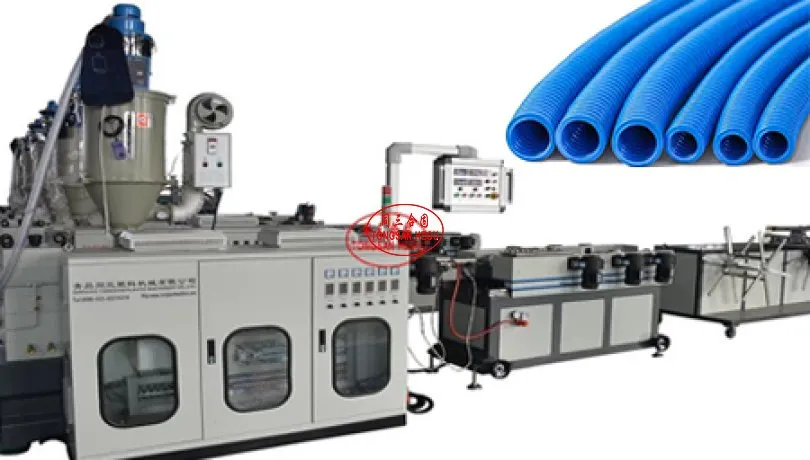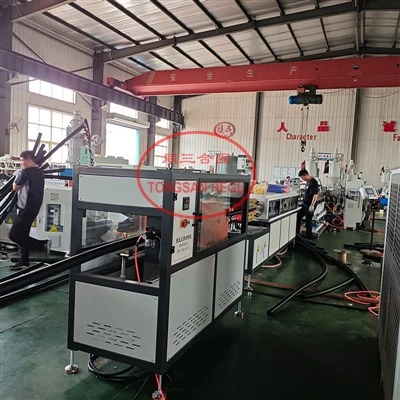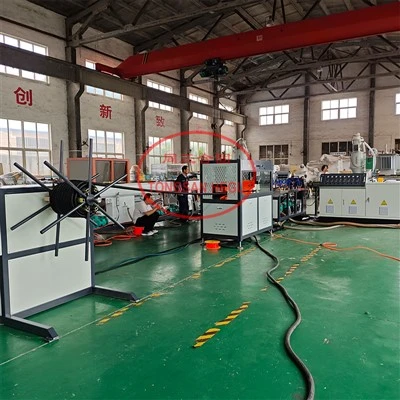
PVC single-walled bellows is made of polyvinyl chloride (PVC) composite material as the main raw material and is made by extrusion blow molding process. The inner and outer surfaces of single-walled bellows are corrugated, and their annular groove structure makes it both rigid and flexible of a hose. Although its bendability and flexibility are excellent, its fluid resistance is large, and it is easy to cause the deposition of suspended solids in the inner surface spiral groove. Therefore, PVC single-walled bellows are mostly small-diameter pipes with thin walls, low strength requirements and need to be bent freely, such as threading pipes, drainage pipes, exhaust pipes, etc. In addition, it is also widely used in power communication cable protective covers, building threading sleeves, sports field drainage systems and air conditioning drainage pipes.
The inner diameter or outer diameter of the single-walled bellows is the basic structural parameter, and other factors such as wall thickness, wave distance, wave thickness, etc. are determined based on the inner diameter or outer diameter. The corrugated height can be expressed by the wave depth coefficient K, which is the ratio of the outer diameter of the bellows to the inner diameter, and the higher the value, the higher the height of the corrugation. The waveform of bellows can be divided into spiral, U-shaped, C-shaped, S-shaped, V-shaped and Ω-shaped according to the geometry after being cut along the axial direction, and the waveform has a certain impact on the stiffness and strength of the tube.
The main difference between PVC single-walled bellows and PVC ordinary pipe production technology is that after extruding the pipe blank of the toroidal section, it is formed into a bellows in the corrugated blow mold while it is hot, see the process flow, production process and forming principle described below.