

I, Wood Plastic PE WPC Production Process – Detailed Full-Line Overview
This complete process covers the entire chain from raw material recovery, compounding, and pelletizing to final profile extrusion and surface finishing. The line can be flexibly configured or simplified based on the customer's raw material form and production capacity requirements.
Step 1: Waste Plastic Recycling & Flaking (Optional)
Raw materials: Waste PP/PE plastics (e.g., films, woven bags, post-consumer mixed plastics).
Process sequence: Sorting → Crushing → Cold/hot washing → Dewatering → Drying → Clean plastic flakes.
Output specification: Regenerated plastic flakes with moisture content < 3%, ready for direct compounding.
Note: This stage can be omitted if the customer purchases ready-made clean plastic flakes or pellets.
Step 2: Plant Fiber Powder Preparation (Optional)
Raw materials: Agricultural residues such as wheat straw, rice husks, wood chips, etc.
Process sequence: Coarse crushing → Fine pulverization → Air-flow/rotary drying → Sieving/grading.
Process parameters: Fiber fineness controlled at 80–100 mesh, moisture content ≤ 3%, to ensure good compatibility with the plastic matrix.
Note: This stage can be omitted if the customer directly purchases wood fiber powder meeting the above specifications.
Step 3: Formulation Weighing & High-Speed Thermal Mixing
Main ingredients: Recycled plastic flakes (or pellets), plant fiber powder (80–100 mesh), coupling agents, lubricants, stabilizers, colorants, and other functional additives.
Operation: All components are precisely weighed according to the specific formula and fed into a high-speed thermal mixer. Under heating (typically 90–120°C) and high-speed stirring, the fibers are evenly dispersed and coated by the molten plastic matrix, while moisture and volatiles are expelled.
Output: A homogeneous, dry pre-mixed powder compound, ensuring stable feeding for the subsequent pelletizing step.
Step 4: WPC Pelletizing (Parallel Twin-Screw Extruder + Hot-Cutting)
Extruder type: Parallel twin-screw extruder, offering excellent dispersive mixing and devolatilization capacity.
Process: The pre-mix is force-fed into the extruder barrel, where it undergoes plasticization, compounding, and vacuum degassing. The melt is then extruded through a strand die and cut into cylindrical or flat WPC pellets via a water-ring or air-cooled hot-face pelletizing system.
Output: Uniformly sized, well-plasticized PE WPC pellets, ensuring stable and consistent feeding for profile extrusion.
Note: If the customer purchases ready-made PE WPC pellets, this step and the preceding Steps 1–3 can be entirely omitted.
Step 5: WPC Profile Extrusion & Forming (Conical Twin-Screw Extruder + Calibration/Traction/Cutting)
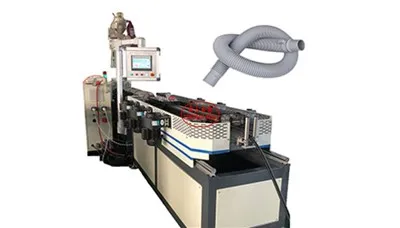
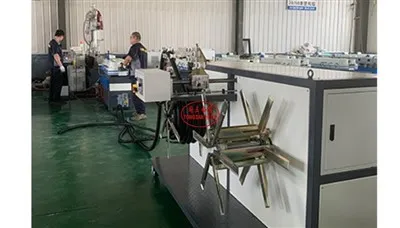
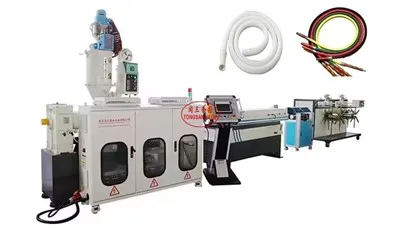
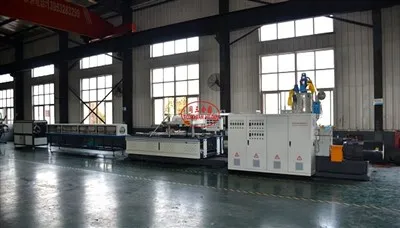
Extruder type: Conical twin-screw extruder (e.g., SJMS65/132 series), specifically designed for high-fill, low-flow WPC materials, featuring high torque, low shear, and strong pressure-building capability.
Mold system: Custom-designed flow channels and molds tailored to the final product (decking, wall cladding, fencing, posts, pergola profiles, etc.).
Calibration & cooling: After exiting the die, the profile passes through a water-cooled sizing table (vacuum calibration) to precisely control dimensional tolerances and straightness.
Haul-off & cutting: A caterpillar haul-off unit pulls the profile uniformly, while an in-line fixed-length cutting saw automatically cuts it to preset lengths.
Output: Continuously produced WPC base profiles with stable dimensions and a dense, compact surface.
Step 6: Surface Texturing (Optional Post-Finishing Processes)
To give WPC profiles a more realistic wood-like appearance and tactile feel, one or more of the following surface treatment options can be integrated according to customer requirements:
In-line Embossing: While the profile is still in a hot state, an embossing roller presses a three-dimensional wood grain pattern onto the surface. Pattern depth and design can be customized.
Sanding: A sanding machine performs fine surface grinding to remove burrs and achieve a smooth, flat finish.
Brushing/Scratching: Rotating wire or nylon brush rollers create longitudinal grooves along the profile surface, mimicking the natural grain texture of solid wood.
These treatments can be applied individually or in combination, and the final surface effect can be tailored to match customer samples. Additional decorative processes such as coating or lamination can also be added if needed.

II, Main machine for PE WPC project
1, WPC granulation machine
| Model | L/D ratio | Max.capacity | Motor power | Suitable material | Max.rotating speed | Wood powder percentage |
| SHMS-65 | 40:1 | 200-220kg/h | 75kw | Pe+wood powder | 500r/min | ≤75% |
| SHMS-75 | 40:1 | 300-350kg/h | 90kw | Pe+wood powder | 500r/min | ≤75% |
| SHMS-90 | 40:1 | 500-600kg/h | 132kw | Pe+wood powder | 500r/min | ≤75% |

2, WPC profile extrusion line
| Model | HGMSE-65 | HGMSE-80 |
| Extruder model | SJMS65/132 | SJMS 80/156 |
| Motor power | 37kw | 75kw |
| Mac.Extrusion capacity | 140-160kg/h | 220-250kg/h |
| Co-extruder(Optional) | SJ35/28 | SJ45/28 |

3,We have high quality Online embossing device.it can do amazing 3D embossing design

4,WPC brushing and sanding machine
This machine is used for doing surface treatment of different WPC product. This machine has the function of sanding machine and brushing machine.

III,PE WPC Products Application for Outdoor Landscape


Hot Tags: pe wpc fence extruder productionh line, China pe wpc fence extruder productionh line manufacturers, suppliers, factory, PE WPC Production line, PVC Profile Extrusion Line, PVC WPC Wall Panel Making Machine, Wood Plastic Composite Extruder, Wood Plastic Composite Machine, WPC Decking Making Machine